


To expand and collapse the navigation please click on the headings
Go to other Related Subject areas


Archaeological Fieldwork at Sheinton 2004-2006

Fieldwork at Sheinton
In 2004-6 the Archaeology Service has been working with a local group exploring the archaeology and heritage of Sheinton, Shropshire.
Sheinton is a small village about 14km southeast of Shrewsbury. The village is sited on a river terrace overlooking the River Severn to the north. There has been a settlement at Sheinton since late Saxon times at least, and because of the lack of large-scale modern housing development, there is a strong probability that the archaeology of the early settlement here is well-preserved. Outside the bounds of the modern village, cropmark evidence and find-spots of artefacts have provided evidence for human activity and settlement in the prehistoric and Roman periods.
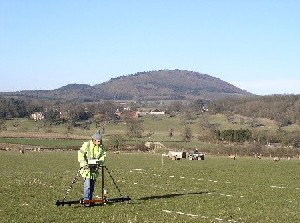
A resistivity survey being carried out at Sheinton by ArchaeoPhysica Ltd for the Sheinton Heritage Group
A local community group, the Sheinton Heritage Group, organised a project - the Sheinton Heritage Project - to investigate the history, archaeology, geology, and natural history of the parish of Sheinton.
The Archaeology Service has helped the group with the archaeological elements of this project with a programme of fieldwalking, geophysical survey, and trial excavation on two sites in the parish.
The Sheinton Heritage Project has been funded by the Local Heritage Initiative and Awards for All.
The first site lay a few hundred metres to the north of the village and was marked by a cropmark first seen on aerial photographs taken several decades ago.
The cropmark appeared to be of a type of enclosure, which has been shown by excavation elsewhere to represent the remains of farmsteads occupied during the late Bronze Age, Iron Age, Romano-British, and early medieval periods.
The cropmark feature at the first site was confirmed as a substantial ditch which had silted up in the early Roman period. The feature is believed to represent part of a ditch that would have surrounded the farmstead in the Iron Age and early Romano-British periods.
The second site was in a field on the edge of the modern village, close to the church, where metal detectorists had recently found several objects of Roman date.
A geophysical survey here indicated the presence of a couple of features which predated the historic field pattern.
Excavations to investigate one of these features, which lay close to the edge of the modern village, recovered a significant quantity of well-preserved Romano-British pottery (mainly of 3rd/4th century date), suggesting occupation in this period close to the modern settlement.
