


To expand and collapse the navigation please click on the headings
Go to other Related Subject areas


Roman Shropshire - (AD 43 - AD 410)

The Roman Invasion
The Roman period in Britain is usually classified as the years between AD 43 and AD 410. It was initiated by a Roman invasion and ended with an edict of the Emperor Honorius who told the British that they must now defend themselves as the stability of the Roman Empire was being threatened by forces elsewhere.
In AD 43 the Roman Army under the Emperor Claudius mounted a successful invasion of Britain. After the defeat of the British tribal leaders by the Romans, 11 tribes of South East Britain surrendered. The Romans set up their capital at Camulodunum (Colchester) and Claudius returned to Rome.
In the following years the Romans pushed westwards into Britain, subduing the native tribes as they went. In AD 47, the Roman Governor of Britain, Ostorius Scapula, waged war against the tribes of Wales, who were particularly troublesome and posed the greatest threat of rebellion. The Silures of South West Wales were a particular problem and they continued to fiercely defend their territory until they were finally conquered in AD 76.
The Romans left an obvious mark on Britain during the time that they were here and this is most evident in the towns that they set up.
Prior to the arrival of the Romans, Britain was very much a disjointed country divided into areas, each governed by a separate tribe with a separate set of values and laws. There was no central administration, no road network and even the currency used varied from place to place.
At the time of the Roman invasion Shropshire was occupied largely by the Iron age Ordovican and Cornovian tribes.
Romans civilise the Britons
After the Romans had conquered Britain they quickly set about Romanising it. That is, introducing Roman customs, government and above all Roman towns to encourage the native people to adopt a Roman identity. It was hoped that introducing the Roman way of life and the advantages it could bring would deter them from rising up in rebellion.
One of the most important ways in which the Romans established their way of life was in the introduction of towns. Prior to the invasion Britons had lived in small communities often made up of a series of family groups and much of their lifestyle had been agricultural and self-sufficient.
The Romans quickly set about building towns as places from which to govern the people they had conquered. As they moved further inland they built more towns and connected them with an efficient road system.
Roman towns were much more advanced than the British settlements, with street layouts, bath houses, shops and government buildings. Shropshire was important in the Roman period in that it became home to the fourth largest walled Roman city in Britain, behind London, Cirencester and St Albans. This town was known to the Romans as Viroconium but we now call it Wroxeter.
Viroconium
At its peak Viroconium was home to more than 6,000 inhabitants and has been described as one of the best examples of 2nd century AD town planning.
The town at Viroconium is entirely of Roman origin and probably started in around AD 47 as a base for Roman troops trying to push deeper into Britain. A small auxiliary fort just to the south of the later town may date from this period, as may one or more of a number of temporary marching camps in the immediate area of the later town.
The site was strategically located at the point where the River Severn could be crossed by a wide ford. Watling Street, an important Roman Road running from London ran to Wroxeter from the north east. From Wroxeter further roads ran to the south west into Gloucestershire, to the north to Chester, and later to the west into central Wales. It was at that early time situated on the western edge of the Roman Empire forming part of the frontier with the still unconquered British tribes in Wales.
The fort at Wroxeter might have have started out as a temporary encampment but in AD 58 Emperor Nero decided to try and secure the Roman frontier by conquering the adjoining Welsh lands. This would have changed the military purpose of the site from temporary camp to permanent garrison, and by the mid 50s AD a fortress had been founded at Wroxeter.
Once life settled down in Roman Britain the role of the settlement at Wroxeter would have changed once again. By the late 1st century, Viroconium would have already had quite a large civilian population as they would have been drawn by the relative safety of the fort and by the financial opportunities of trading with the Roman troops.
Viroconium would also have had its own administration and been fairly autonomous (self-governing) and soon developed into the capital of the Cornovian Britons. The city layout began to expand along the typical Roman grid pattern and a law court, market place and public baths were all installed in this early stage of the city’s development.
The greatest period of expansion for Viroconium began in the early 2nd century and was to continue for almost the whole of that century. This phase saw the construction of a civic centre, together with a basilica (assembly hall) and a very large and impressive bath complex.
By the end of the 2nd century the ditches and ramparts which enclosed Viroconium extended for over 2 miles and many more houses and other buildings had been constructed. It had flourished to become Britain’s 4th largest city.
The late 3rd century saw a downturn in the fortunes of Wroxeter as the country went through a period of unrest. Numerous incursions by barbarian tribes and mounting maintenance costs led to much of Wroxeter falling into disrepair. By the beginning of the 5th century BC the last of the legions had been withdrawn from this part of the Roman Empire and Britain was left on her own to deal with the threat of Saxon invasion.
Strangely, once the troops had left Wroxeter it underwent something of a revival in that the bath house and basilica were renovated and a new hall constructed. It is not known who ordered this work but some scholars suggest that by this time it may have been the base of the legendary King Arthur.
The city is believed to have been finally vacated sometime between AD 500 and AD 650.
Mediolanum (Whitchurch)
Wroxeter, although the largest, is not the only Roman settlement in Shropshire. Whitchurch, 20 miles to the north of Shrewsbury, has it’s origins as a Roman town known as Mediolanum. The name means, ‘place in the middle’ and it was at a major crossroads of routes to Shrewsbury, Chester, London and Wroxeter.
The town was established in c.AD 70 by the Romans on a site halfway between Viriconium (Wroxeter) and Deva (Chester). Several timber-framed buildings with industrial usage had been established by the 2nd century. There were also two wells in operation covered by small rectangular buildings.
Substantial stone buildings were erected in the late 2nd to early 3rd centuries, when the town was at its most productive. Smaller stone buildings were being constructed at the beginning of the 4th century.
A small excavation took place in the front garden of 3 Roman Way, Whitchurch in 1985. The remains of a small Roman (A.D. 43 - 450) structure were uncovered built from Roman pot tile and packed with sandstone, sealed with mortar. A second excavation in the back garden revealed two small pits containing cremated bone and large quantities of potsherds. These finds were part of a Roman burial ground, originally dug outside of the Roman town of Mediolanum (Whitchurch).
Today the town still retains some of its Roman layout and the High Street follows the line of the Roman road.
Roman Lead Mining
There is some evidence that the Romans mined for lead in Shropshire in the hills around Shelve. The lead from these hills is particularly poor in silver content, there being only around 2.5 ounces in each ton of processed lead.
At least 5 lead pigs have been recovered from the area, each with the words IMP HADRIANI AUG moulded into the upper surface, proclaiming them the property of the Emperor Hadrian (AD 117 – 138).
Roman forts and marching camps
At Stretford Bridge, near Craven Arms, there is a Roman fort strategically situated at the junction of several ancient trackways. The fort measured 515ft from north-west to south-east by 320ft, and enclosed an area of 3.75 acres.
It may have been set up as the winter quarters of the force which occupied a nearby temporary camp at Craven Arms in c.AD 48/49. The fort is large enough to have housed a ‘cohors quingenaria’, a 1500 man auxiliary infantry regiment.
There are also several Roman marching camps in the area; two at Stretford Bridge and Craven Arms, one more at Upper Affcot and another one 5 miles away at Bromfield. As well as ones at Quatt (SE of Bridgnorth), Uffington (E of Shrewsbury) and Burlington (NE of Telford).
Roman villas
Roman villas in Shropshire are rare but there are examples at Acton Scott, Yarchester, Cruckton, Lea Cross and Whitley Grange.
The villa building at Acton Scott lies on a south-facing slope above a stream. The building is aligned precisely east-west and appears to have had later additions to the west end. A small bath house was also incorporated within the south-west corner.
Given the proximity of the Romano-British lead mining complex at Linley, about 4 miles to the west, it is very likely that the villa building here is associated with the production of lead, possibly as the residence of the person in charge of operations.
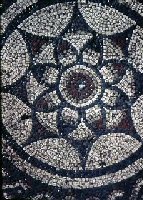
Yarchester Villa Mosaic
The villa at Yarchester (NW of Much Wenlock) consisted of rooms arranged around a central courtyard and it may have been fronted by a colonnade. Part of the villa had a hypocaust (Roman underfloor heating) system and it would appear that the villa was at least partly roofed with lozenge shaped slates. A late 4th century mosaic was also discovered in the room that was most likely the dining room and a variety of pottery sherds from domestic vessels have also been found.
Whitley Grange Roman villa (SW of Shrewsbury) was first identified as such in 1893, when a dense collection of Roman tufa and tile suggested the possibility of a bath house. Fieldwalking and geophysics established the presence of well preserved remains of hypocausted rooms, which suggested a bath house complex.
The bath house appears to have been built in the 3rd century with some work done in the 4th. In 1995 a mosaic was discovered in a room to the south-west of the bath house and this has been dated to the third quarter of the 4th century. The main colours of the mosaic are red, white and green and the central medallion was originally decorated with a bust of Medusa (a mythological creature with snakes for hair who could turn men to stone just by looking at her).
The residential part of the villa would appear to consist of a service corridor and only three rooms, not large enough for permanent habitation. It may be that the residential wing lies undiscovered elsewhere on the site or that the remains are that of a country retreat or somewhere to relax at weekends.
Lea Cross Roman villa was first discovered in 1793 then rediscovered in 1956 and partially excavated in 1969. The excavation revealed at least three stages of construction within the site. The first phase consisted of a large building with walls 4ft thick, it was probably the site of the bath house. The second phase used the foundations of the first building, which was now ruinous. The floor level was raised by 2ft and rubble infills containing 3rd century pottery were found. The building was now probably used for industrial purposes or again as part of a bath complex. The third phase involved the construction of a large timber outhouse against
the NE corner of the original building. Very few pottery sherds from the 4th century were discovered from the site, which suggests that it had been abandoned by this time.
Roman roads in Shropshire
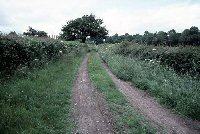
Watling Street
As the Romans built their villas and laid down their towns throughout Britain they also set up communication networks between them. Roman roads were highly efficient and built to the straightest line possible so as to take the shortest route. The makeup of the road was also highly developed. A trench would be dug to the length and width of the road. A layer of large stones was then laid down. This was followed by a layer
of large pebbles, sand and cement, which was pressed down to make a solid base. The final layer was made up of stones fitted together very tightly to create an even surface. At the sides of the road stone lined channels were dug to drain away any surface water.
In Shropshire there are 4 routes of Roman roads that can be followed today. The first, and probably the most famous, is Watling Street, which ran from London to Wroxeter. Watling Street was one of the first major Roman roads in Britain and was built in the 1st century AD, soon after the Roman conquest. It was later extended to run from London to the port at Dover.
From Wroxeter Watling Street ran north-west towards Mediolanum (Whitchurch) where it divided. The north-west route continued on into the Roman town of Deva (Chester), while the north-east route later crossed the River Mersey and continued as the West Coast road.
To the south of Wroxeter was a roman road, which is sometimes described as Watling Street West, and this ran to Magna (Kenchester) via Bravonium (Leintwardine), both in Herefordshire and then on to Isca (Caerleon) in South Wales
To the south of Shrewsbury is a Roman road which crosses the River Severn near Montgomery. This was known as the Forden Gaer.
There is also a Roman road near Newport (in between Shrewsbury and Stafford) which runs north to Whitchurch and onto Chester. This road is now the route of the modern A41.
These roads would have enabled communication, and more importantly trade, to occur between Shropshire and the rest of Roman Britain. It would have brought people into the area and with them new technologies and goods.
