


To expand and collapse the navigation please click on the headings
Go to other Related Subject areas


Bridgnorth Castle
Bridgnorth Castle was founded by Robert de Belleme, Earl of Shrewsbury and a powerful Norman baron. Robert was a particularly nasty character who was said to refuse to ransom prisoners so that he could have the pleasure of torturing them to death. He is also said to have impaled men and women on hooks and once starved 300 prisoners to death over Lent. One of the most gruesome stories connected with Robert de Belleme is that he once gouged out the eyes of his grandson with his own fingers after an argument with his godson’s father.
In 1102 King Henry I besieged Bridgnorth Castle for three weeks in an attempt to keep Robert under control. During the siege Henry had a siege castle built nearby so that his troops could fire catapaults into the castle. The earthworks can still be seen in the town today and are known as Pan Pudding Hill. Robert de Belleme was defeated and his castles confiscated. For the rest of his life Robert was held as a prisoner.
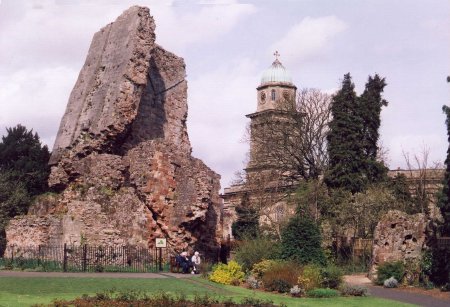
Bridgnorth and Church
During the civil war between Stephen and Matilda, Bridgnorth Castle was taken by Hugh de Mortimer. He was dislodged following a siege in 1155 and Henry II took control. The Pan Pudding Hill siege earthworks were reused at this time as well as during the Baron’s Revolt in 1321 and the English Civil War in 1646.
Between 1155 and 1189 both Henry II and John undertook extensive building works to strengthen and extend the castle. The keep dates from this period and a barbican was added later. Further construction work was carried out in the early 1200’s. Once Edward I had managed to extend his powers into Wales, Bridgnorth lost its strategic importance as a castle of the Marches and fell into decline.
In 1646, Bridgnorth underwent a 26 day siege by Parliamentary forces. This time the besiegers blew up the keep, which resulted in the structure leaning by 15 degrees (3 times more than that of the famous tower in Pisa!). During the 1646 siege a large part of the town was set on fire. As
a result there are no verified images or detailed accounts of the actual layout of Bridgnorth Castle before its destruction.
