


To expand and collapse the navigation please click on the headings
Go to other Related Subject areas


Shrawardine Castle

Two Castles
Shrawardine is a small settlement about 7 miles to the northwest of Shrewsbury. The area was once home to two castles. The village is on a ford across the River Severn and a castle was built on each side of the river in order to guard the crossing. The castle on the western side of the river is technically in Little Shrawardine.
The western castle had been originally built in the Norman motte and bailey style - a large mound with a wooden keep (tower) on the top. Almost nothing remains of this castle today and the site has been much eroded by the river. This castle was abandoned some time in the 12th century and to make up for this weakening of defences the castle on the eastern side was strengthened in stone.
In 1165 we have documentary evidence of a Philip Helgot owing guard service at the castle.
Attacked by the Welsh
In 1171 Shrawardine Castle came into the possession of the Crown and King Henry II who ordered money to be spent on repairs.
In 1215 the castle at Shrawardine was attacked by the Welsh, led by Prince Llewellyn. The castle would appear to have been quite badly damaged during the trouble as King Henry III ordered it to be rebuilt five years later. In 1229 it was handed over to the powerful FitzAlan family, who were also in charge at Oswestry Castle.
Castle Isabel
The FitzAlan family continued to improve Shrawardine Castle and under John FitzAlan the castle was rebuilt and renamed it Castle Isabel after his wife.
After the 13th century the area around Shrawardine became much more peaceful and Saxton’s map of Shropshire, which was created in 1577, shows the castle at Shrawardine with a wall or fence around it. This may indicate that the castle’s military presence had been downgraded to that of a fortified manor house.
Shrawardine Castle in the Civil War
The castle remained in the hands of the Fitzalan family for around 350 years before coming into the possession of Thomas Bromley, Lord High Chancellor of England in 1583. When the English Civil War broke out in the 1640’s Bromley showed his allegiance to King Charles I by placing a garrison of 300 men at Shrawardine Castle in 1645. Opposition troops of the Parliamentarian cause set up camp around the castle and laid siege to it. Just five days later the Royal garrison surrendered, a move which created controversy and led to the defenders being accused of cowardice.
The Parliamentarians then set about ensuring that Castle Isabel would not be used against them again and they burnt it down and much of the remaining stone was taken away for building elsewhere, some of it most likely went to Shrewsbury for new defences.
Recent findings
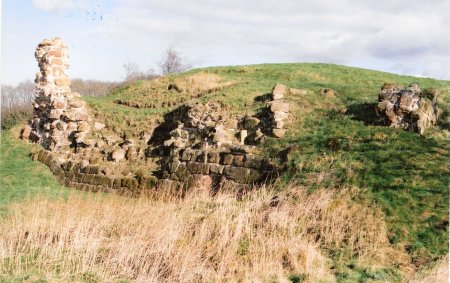
Shrawardine motte - remaining masonry
The site of the castle was later used for agricultural purposes before being purchased by the Montford Parish Millennium Green Trust who turned it into a village green. We have very little information as to what Shrawardine Castle actually looked like but a survey in 2001discovered that the castle consisted of a substantial curtain wall with single towers at three corners and a double tower in the fourth.
The survey also revealed that the original castle consisted of an rectangular earthwork mound, with a timber tower on top. The motte was surrounded by a large ditch, to the east of which was an oval outer enclosure, or bailey, which would have had timber buildings including the domestic quarters, kitchens and stables. The bailey was later enlarged with the addition of an outer bailey on the south side.
Reports from the Civil War suggest that the Royalist defenders levelled part of the village, including the church to give less opportunities for attacks. Geophysical survey carried out in the area also suggest that a former track to the west of the castle may have once been lined on either side with a number of buildings.
Today nothing survives of the castle apart from the motte and a few pieces of the walls.
