


- Main
-
Related Webpages
- Four Parishes Heritage Group
- Twentieth Century Shropshire
- Four Parishes Research Pits and pools
- Billingsley Colliery
- The Highley Mining Company
- Introduction to Stottesdon
- Introduction to Kinlet
- Proposed canal and mines at Billingsley and Kinlet
- Highley Forum articles on the local iron industry
- Memories of a pit carpenter; George Poyner
- Highley Forum articles on mines and miners
- Thomas Crump's account of mines in Chorley, c1800
- Report on Kinlet Colliery 1903
- Billingsley Furnace
To expand and collapse the navigation please click on the headings
Go to other Related Subject areas


Introduction to the Wyre Forest Coalfield
An introduction to the history of the Wyre Forest Coalfield. For further information on individual mines or allied industries, look at the related webpages menu
The Wyre Forest Coalfield
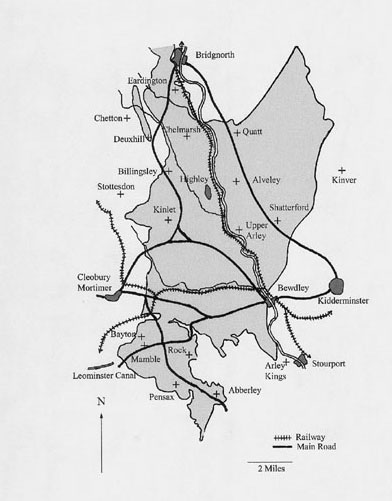
This map shows the Wyre Forest Coalfield
The Wyre Forest Coalfield covers an area of around 50 square miles, on the borders of Shropshire and Worcestershire, centred on the Wyre Forest. Although this gives the coalfield its name, paradoxically there is virtually no workable coal beneath the forest itself. This is found in two distinct deposits, either side of the forest.
There are two distinct types of coal found in the Wyre Forest coalfield. The sulphur coal is the only coal found in the southern part of the coalfield and it is the form found nearest to the surface over most of the northern part of the field. As its name suggests, it has a high sulphur content and produces an acrid, unpleasant smoke when burnt. The high sulphur made it unsuitable for metal working and meant it was difficult to burn on a household fire (although some seams were used as a domestic fuel). On the other hand it was perfectly acceptable for brick making and it was much prized by hop growers. They used it to dry their hops; the sulphurous fumes gave the hops a distinctive flavour when used to make beer. The second type of coal found is the sweet coal. This has a much lower sulphur content and was suitable for both domestic and industrial users. It is found only in the northern part of the coalfield. It outcrops on the western fringes, in the parishes of Neen Savage, Stottesdon and Billingsley, but within a short distance it becomes buried under the sulphur coal. The most important seam was the Broach Coal, around 4’ thick.
Other minerals found with the coal include clay and ironstone; both of these were worked commercially. Thin beds of limestone were also exploited, as were the thick deposits of coal measure sandstone, especially around Highley and Alveley.
Mining first started in the coalfield in the Middle Ages; the first mines were probably for ironstone. However, by the end of the 16th Century coal mining was underway and this soon became dominant. In the 17th and 18th centuries there were numerous small mines, working the coal where it was shallowest. However, around 1800 larger mines were sunk at Highley and Billingsley. These had comparatively short lives, but towards the end of the 19th Century deep mining returned, first to Billingsley and then to the Highley area. The largest concern was the Highley Mining Company who worked Highley, Kinlet and Alveley Collieries and who also took over Billingsley Colliery. Alveley Colliery was taken over by the National Coal Board in 1947 and received considerable investment in the late 1950s. However it was closed as uneconomic in 1969.
The related webpages include documents that relate to the different mines in the northern part of the Wyre Forest Coalfield.
