


- Main
-
Related Webpages
- Medieval Shropshire (AD 1066 to AD 1500)
- Tudor and Stuart Shropshire
- Haughmond Abbey
- Lilleshall Abbey
- Bridgnorth Friary (in depth)
- Alberbury Priory
- Austin Friars in Shropshire
- Carmelite Friars in Shropshire
- Chirbury Priory
- Dominican Friars in Shropshire
- Monastic Orders in Shropshire
- Much Wenlock Priory
- Franciscan Friars in Shropshire
To expand and collapse the navigation please click on the headings
Go to other Related Subject areas


Religion in Medieval and Tudor Shropshire
After the Norman Conquest
The Normans who came to England to fight at the Battle of Hastings were very religious and so they brought their consciences (sense of right and wrong), the monks, with them. As killing was a sin it required 120 days penance for each man killed. The Norman knights were too busy to carry out this duty themselves and so would often pay a monk to carry out the penance for them, thus absolving (clearing) their conscience.
Monks were a community of religious men who believed that a life of denial of the pleasures in life could bring you closer to God. Poverty, chastity and obedience were also elements of their belief. Monks (and their female counterparts the nuns) renounced all possessions, took a vow of celibacy and devoted themselves to a life of quiet contemplation and prayer.
When the monks first arrived in the country they set up religious communities with very basic facilities. However, the money they began to receive for praying for people’s sins brought in quite a substantial amount of revenue and so they used it to build impressive stone monasteries. They justified this spending, despite their vow of poverty, as they stated it was being used for the glorification of God.
Before the Conquest there were no regular monastic foundations in Shropshire, only a small number of minster churches. After 1066 there was a series of new foundations made. Shrewsbury Abbey was founded in 1083 and Buildwas in c.1148. Priories at Chirbury and Alberbury in the late 12th century had their origins as Saxon minsters.
As part of the Catholic Church the first loyalty of the monks was to the Pope in Rome. There were several different orders of monks and at one time Shropshire had 9 different orders of monks, canons and friars as well as a nunnery.
Religion was fast becoming a good way to earn money and one way to guarantee an income was the relics (bodily remains) of a saint. The first monastery to be set up in Shropshire was on the site of Much Wenlock Priory, at some time in the 7th century. The monks of this monastery discovered the remains of St. Milburga nearby and she was reburied in front of the high altar and the money from pilgrimages began to flood in.
Shrewsbury Abbey was another community that was quick to cash in on potential pilgrimages. The monks here had been brought to the area by Roger de Montgomery in 1083. They later decided to exhume the remains of St. Winifride, who died in the 7th century, and placed her bones in a shrine at the Abbey. Pilgrims then flocked to the Abbey to view the scared remains, which would have created a considerable income for the monks. Even King Henry V is said to have made the journey to come and see them.
The wealth of the monks naturally drew criticism and there are numerous stories of hard drinking, womanising, gluttony and high living associated with them.
Henry VIII
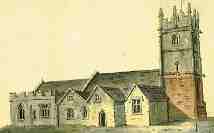
An old image of St. Julian's Church, Shrewsbury.
By the beginning of the 15th century monasteries owned more than a quarter of all cultivated lands in England. However, with the accession of Henry VIII to the throne the days of the monks were numbered.
When Henry VII came to the throne of England in 1485, as the first Tudor monarch of England, the religion of the country was Catholic. When Henry VIII became King in 1509, Catholicism was still the religion of England, but all this was to change.
By 1530, Henry was looking to divorce his first wife, Catharine of Aragon, but he had a problem in that the Catholic religion did not allow divorce and the Pope in Rome (who was Head of the Catholic Church) refused his request. As the Pope wouldn’t grant permission Henry took a drastic step and claimed jurisdiction (control) over the Church of England. In 1534, he issued the Act of Royal Supremacy, which stated that the English Crown was reclaiming powers that it had always possessed but that had been commandeered by Rome.
As the monks were still loyal to the Pope they posed a problem for Henry and he decided to get rid of them. The monks were some of the wealthiest people at the time and they not only appeared to live quite comfortable lives but also owned large areas of land, which provided them with additional income as they could rent it out or farm it.
In 1535 Henry VIII sent out inspectors to the monasteries in England to write reports on their wealth and moral conduct, many of the reports which favoured the monasteries were sent back and the inspectors ordered to be more critical. He then set about closing the monasteries and seizing the property for the Crown. This process was known as the Dissolution of the Monasteries.
The smaller monasteries were closed by 1536 with the larger ones following over the next four years. Some of the monastery buildings were quickly reduced to ruins as the population was allowed to take what they wanted as long as all the silver and gold went to the Crown. In 1546, in anticipation of a stripping of assets by the Crown the parishioners of St. Julian’s Church in Shrewsbury are said to have removed the most valuable goods.
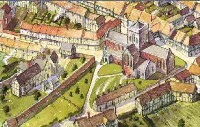
St. Chad's Church and College area, taken from the Tudor Shrewsbury Interactive Map.
In Shropshire most of the monastic and chantry estates confiscated by the Crown eventually came into local hands. In 1544 three friaries were bought by the draper and alderman Roger Pope. The collegiate churches were converted to gentlemen's residences. St. Chad's College, dissolved in 1548, was partly purchased by a London and Shrewsbury merchant. The most valuable property appropriated by the Crown consisted of the lands belonging to Shrewsbury, Haughmond and Lilleshall abbeys.
Before the dissolution of the monasteries Henry had been on the point of bankruptcy. He had fought some very expensive wars in Europe and was in desperate need of funds, the monasteries at this time owned over one quarter of the land in the country.
England now began to turn away from the Catholic faith and embrace Protestantism (a branch of Christianity that placed more emphasis on the teachings of the Bible than church traditions). For the remainder of Henry’s reign few major changes were made to the practice of religion but he did have the Bible translated from Latin to English and by 1538 all Parish Churches were expected to carry an English version.
Edward VI
On the death of Henry VIII in 1547 his son Edward VI took the throne at the age of nine. He was the first monarch to be a Protestant at the time of taking the throne and it was during his reign that Protestantism was fully established in England. It was also during Edward's reign that Thomas Cranmer, the Archbishop of Canterbury, implemented the ‘Book of Common Prayer’. The introduction of this book was frowned upon by most of England and there were rebellions against it.
In churches stained glass windows, shrines, statues and other Catholic relics were removed and the requirement that the clergy remain celibate was done away with, allowing them to marry. Elements of the old religion and its festive calendar persisted for almost as long as it proved feasible in Shrewsbury. The Corpus Christi procession was kept until 1547, and although images were later burnt in the market place following the July injunctions, in 1548 civic drinking was pointedly kept on Trinity Sunday and the Feast of Relics.
Shrewsbury appears to have accepted the religious changes of the Reformation quite easily with very little argument or rebellion.
Edward VI died at the age of 15 with no heirs to continue his Protestant reforms. The throne was contested and after Lady Jane Grey had ruled as Queen for only nine days, Mary I took the throne. Mary was Henry VIII’s eldest daughter by his wife Catharine of Aragon, who once lived at Ludlow Castle when she was married to Henry VIII’s brother Arthur.
Mary I
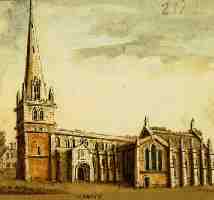
St. Mary's Church, Shrewsbury.
Mary was a staunch Catholic and quickly set about undoing the reforms her half brother Edward had made to the English Religion, turning once again to Catholicism. Mary quickly married Phillip II of Spain (son of the Holy Roman Emperor) in the hope that she would produce an heir to the English throne and prevent the Crown from falling into the hands of her Protestant half sister Elizabeth. During her reign Mary had 283 Protestants burnt at the stake for heresy (opinions against the Catholic Church), which was more than double the number that had been executed in the last 150 years and earned her the nickname ‘Bloody Mary’.
During her reign Mary re-introduced all the Catholic trappings of religion. The Catholic Mass was restored and Holy Communion was banned. All priests had to be Catholic and services were once more in Latin. The Pope was also reinstated as the head of the Church. The churchwardens in Shrewsbury were happy enough to restore the Catholic Church and in fact most of the objects they had removed under King Edward had simply been put in storage.
At St. Mary’s in Shrewsbury, the high altar, rood loft, Easter sepulchre and paschal candle were all restored within a year.
Mary died childless in 1558 and Elizabeth I (Henry VIII’s youngest daughter) inherited the throne. In 1559 Elizabeth passed the Act of Supremacy, which named her as Supreme Governor of the Church of England and re-established England’s independence from Rome. She also passed the Act of Uniformity in the same year which forced everyone to attend an Anglican church service on a Sunday. This was strictly monitored and if you were found to be not attending you could be taken to court.
Elizabeth I
Mary died childless in 1558 and Elizabeth I (Henry VIII’s youngest daughter) inherited the throne. In 1559 Elizabeth passed the Act of Supremacy, which named her as Supreme Governor of the Church of England and re-established England’s independence from Rome. She also passed the Act of Uniformity in the same year which forced everyone to attend an Anglican church service on a Sunday. This was strictly monitored and if you were found to be not attending you could be taken to court.
