


To expand and collapse the navigation please click on the headings
Go to other Related Subject areas


Park Hall, Oswestry
Introduction
Park Hall was one of the finest Tudor mansions in England, prior to its destruction by fire on Boxing Day, 1918. It stood about one mile to the east of Oswestry, and was built by Robert Powell towards the end of the 16th century, although the exact date is uncertain. The Hall was 126 feet long, and the main hall was 33 feet long. There was a small chapel contained in the west wing, with stained glass windows and an oak paneled ceiling. The house itself contained much fine furniture and paintings, many of which were displayed in the long gallery, extending nearly the entire length of the house.
Through various childless marriages, the estate passed from family to family until in 1870 it was bought by Mrs. Wynne Stapleton Cotton, later to marry her second husband, Alfred Wynne Corrie, and become Mrs. Wynne Corrie.
World War I
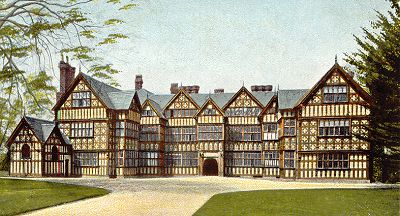
At the outbreak the First World War, Major Wynne Corrie moved into Shrewsbury, and handed over the Hall to the military as their local headquarters. The first Oswestry knew of this was a small paragraph in the Border Counties Advertiser in November 1914, when it was announced that 14,000 troops would soon be arriving. Within a fortnight, the estimate had risen to 21,000 troops with 4-500 officers.
Although it had been a wet and miserable winter, by Spring of 1915, over 900 labourers were busy constructing the camp in the grounds of the old Hall.
In July 1915, the first 4,000 troops of the Royal Welsh Fusiliers and the Cheshire regiment arrived at the Hall. They disembarked at Whittington Station and marched to the camp with the Fusilier's mascot, the goat, talking the lead.
The camp was in constant use throughout the war, training and dispatching troops to the Front. This training was not, however, without its share of tragedy and humour.
The fire of 1918
Just before midnight on Boxing Day, 1918, a fire started in the Chapel of the Hall and quickly spread to the rest of the building. The Oswestry Fire Brigade was in attendance very quickly, but the lack of an abundance of water restricted their efforts to a great degree. The Shrewsbury Brigade was called to assist, and it was a matter of pride in the local newspaper that they arrived at the blaze within one and a half hours! The timber framed building burned so quickly that there was little the Brigades could do, and the Hall was destroyed.
The actual cause of the fire was thought to be an electrical wiring fault that had ignited dry timber on a beam. It was later believed that there had been a chain of events leading to the fire. Only one month before there had been a large fire in the military electricity generating plant, situated in the old coach house. This had meant the diverting of power and an extra load put on the house generator, so putting a strain on the old and decayed wiring. This second tragedy in Major Corrie's life seems to have affected him greatly, for he died in the following April.
The inter-war years
Following the end of the Great War, the now ruined Hall and its surrounding military establishment began to fall more and more into disrepair. The camp hospital, however, was still in use, and the Baschurch Convalescent and Surgical Home, set up by Agnes Hunt, moved here in February 1921. It then became known as the Shropshire Orthopaedic Hospital. Since that time it has become world renowned for its pioneering work in the treatment of all forms of physical disablement.
The land became the property of Oswestry Borough Council. One of the main uses of the land in the 1930's was for motorcycle racing, and it became quite a well-known circuit, with Isle of Man TT riders competing on occasions.
World War II
In May 1939 the land was earmarked once more for military use, with the expectation of four battalions being on site by the following July. As a result, construction crews moved in and within a very short time, the camp began to take on the shape that it was to retain for many years.
To assist the movement of troops, a small station, the Park Hall Halt had been built in the early 1920's. This was now re-opened and was in regular use throughout the war.
By mid-July 1939, the new batch of 2,500 Royal Artillery Militiamen was installed, learning basic skills and gunnery instruction. This was the start of a 30-year Royal Artillery association with Park Hall.
Up to the present
The camp continued to be used for training for many years to follow. The Royal Artillery were joined by the Infantry Junior Leaders until the Artillery left in 1968. The Junior Leaders continued at the Camp until its closure in December of 1975.
Eventually, a lot of the land reverted to farmland, and light industry started on the site of the old encampment. The sports facilities of the camp were excellent, so the grounds and pitches were retained, and are still used to this day as a vital part of the local sports environment.
Park Hall Farm became a visitor attraction in 1998. It is now home to the Museum of the Welsh Guards, continuing the link with the military started so long ago in 1915.
Further information
This account has been abridged from the pages contained within the Shropshire Routes to Roots website which contains additional information and images of Park Hall and its use as a hospital.
Related Links on other Websites
- Robert Jones and Agnes Hunt Orthopaedic Hospital (Shropshire Routes to Roots)
- Park Hall (Shropshire Routes to Roots)
