


To expand and collapse the navigation please click on the headings
Go to other Related Subject areas


Selattyn Hill cairn

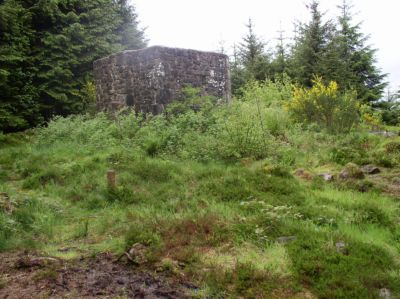
Belvedere tower on Selattyn Hill
Selattyn Hill
Selattyn Hill is situated about 5km northwest of Oswestry in northwest Shropshire. Selattyn Hill is an outcrop of carboniferous limestone and millstone grit, rising to 372m above sea level, giving extensive views of up to 100km across northeast Wales and Cheshire (and beyond), and north through to southeast Shropshire.
The ring cairn
The cairn on Selattyn Hill appears to be a typical example of an early Bronze Age ring-cairn, comprising a low, stone bank enclosing a flat open area. A gap in the bank on the southwest side of the cairn may be an original entranceway into the cairn or may be partly or entirely the result of later erosion.
The cairn is situated on the eastern side of the summit of the hill, on ground that slopes slightly to the east. The monument consists of a spread of rounded boulders surrounded by a low, circular bank of c. 22m diameter, also of large rounded boulders. The southwest side of the bank is very degraded, and areas of rubble of dressed limestone and boulders, some with mortar still adhering, derived from the ruins of the tower are scattered about the cairn, particularly on its eastern side. Some stones are exposed on the western circuit of bank, and again some of these also had mortar attached.
The belvedere tower
In 1847, a belvedere tower was erected on Selattyn Hill by a Mr Crewe of Pentrepant to commemorate Prince Gwên, one of the sons of Llywarch Hen, a sixth century British prince, who, according to legend, was killed in a battle between the British and Saxons near to the Morlas Brook, which runs c. 0.5km to the north of the hill. The tower was erected within the ring cairn, just to the south of its centre, and it was presumably during the construction of the tower that an urn containing human remains was found - according to the OS 1st edition 1:2500 plan, an urn containing human remains was found in the cairn in 1847.
The Home Guard
During World War II, the tower was used as a look-out post by members of the Local Defence Force Volunteers. The tower was already in a ruinous state, and the LDF volunteers put up a corrugated iron roof over the tower.
Forestry and repairs
In the early 1970s, the landscape of Selattyn Hill changed dramatically when the entire hilltop was ploughed and planted with conifers. The ruins of the tower and the cairn were lost from view amongst the maturing trees until relocated in 1997 by members of a local group, the Selattyn Village Project Group
In 1998 the Archaeology Service and the Selattyn Village Project Group carried out an archaeological survey and some trial excavations on the cairn, in advance of repair works to the belvedere tower.
Barrows and cairns
The terms barrow and cairn are used to describe the mounds of earth or stones which have been placed over human remains, either inhumation burials or cremations, from the Neolithic through to the Viking periods. Cairns are usually found in upland areas, and are composed largely of stone. Ring-cairns are just one form of these ritual funerary monument, comprising a circle of stones enclosing an open, flat area containing burials. They are mainly found in Scotland and Wales, with a few in upland areas of England (eg the south Pennines), and generally date to the early Bronze Age.
