


To expand and collapse the navigation please click on the headings
Go to other Related Subject areas


Archaeological investigations at Rectory Wood, Church Stretton 2009

Archaeological investigations at Rectory Wood, Church Stretton
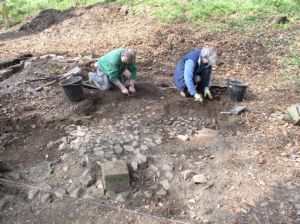
Excavating the summerhouse
In March 2009 the Archaeology Service led a community archaeology investigation at the Rectory Wood and Field Countryside Heritage Site on behalf of the Rectory Wood Heritage Project. The investigations included the trial excavation of two buildings, an icehouse and a summerhouse, within a former 18th and 19th century landscaped garden.
In 1749 Professor John Mainwaring, a theologian and Fellow of St. John's College, Cambridge, became Rector of the parish of Church Stretton. Among the society visitors to Mainwaring’s house (the Old Rectory) was his friend, Lancelot “Capability” Brown. A plan of 1767 shows that Mainwaring had been improving the grounds of the rectory since before this date and he continued to do so through the next decade. Capability Brown is believed to have advised on these improvements. A subsequent Rector, T.B. Coleman, rebuilt the Rectory in the early 19th century to improve its views, and his successor, R N Pemberton, undertook further improvements to the gardens, which probably included the felling and replanting of much of Mainwaring’s woodland.
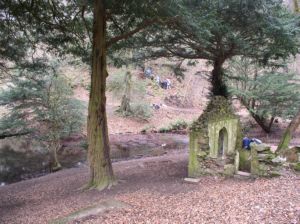
Location of the icehouse excavations
The site of the icehouse was thought to lie on the side of the hill sloping down to the south side of the Yew-ringed Pool. A hollow cut into the bedrock of the hillside marked the probable site of the chamber, though there were no visible remains of this. Two parallel rows of moss-covered stones marked the possible site of an entrance into the icehouse.
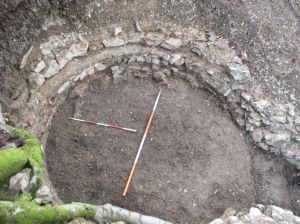
The chamber of the icehouse
Leaf-mould, topsoil and hill-wash were removed from the site by hand to reveal the chamber, entrance-passage and wing-walls of the icehouse. The chamber was cut into the bedrock on the hillside overlooking the yew-ringed pool. The chamber had an inner diameter of 3m and was built with local Longmyndian sandstone lined with red brick. The chamber was entered by an entrance passage and the walls of the entrance passage turned outwards to form wing-walls on the side of the path to either side. The icehouse probably dated to the late 18th century.
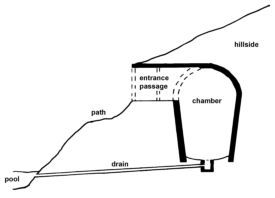
Cut-away section through an icehouse similar to that in Rectory Wood
An icehouse is a structure built for storing ice. These structures allowed ice to be packed into a compact space and their walls and roofs were usually insulated to slow the melting process. Icehouses started to become features in the formal gardens of country houses from the early 17th century, and by the mid 19th century most country houses would have had one or more icehouses on their estate.
It was soon realised that perishable food – meat, poultry, game, fish, butter, etc could be preserved for longer by being stored in the icehouse along with the ice.
The ice came from natural or artificial ponds on the estate (sometimes purpose-built for creating ice in freezing weather). As the road, canal and railway networks improved and developed, ice could be brought in from further afield, particularly in mild winters, and by the mid 19th century ice was being imported from Norway and America.
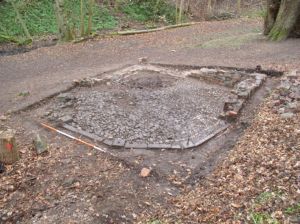
The excavated walls and floor of the summerhouse
A low mound with some brick, stone, and mortar fragments visible in the topsoil marked the site of a possible building at the northwest end of the site. When a thin layer of leaf-mould and loam were removed three walls of a D-shaped structure were revealed. The walls were built of local stone and fragments of re-used brick. The southeast half of the structure was open and six square-section stone pillar bases marked the 5-sided curve of the building. Three of the pillar bases still had iron spikes in the centre for fixing to the pillars that would have supported the roof. The upper part and roof of the summer house would have been timber.
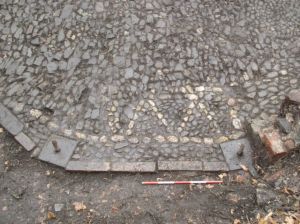
The letter M picked out in cream coloured pebbles
Inside the walls was a pebble and cobble floor surface. The edges of the floor were kerbed in buff brick and stones. Set into the floor at the northeast edge of the building was a mosaic of pebbles, with the letter “M” in a rectangular border picked out in white pebbles.
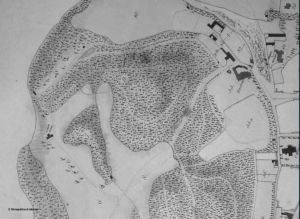
Extract from an 1834 plan of the Rectory gardens (courtesy of Shropshire Archives)
The maps show that the summerhouse was built some time between 1767 and 1834, and the letter “M” set into the floor suggests that it was built by John Mainwaring as part of his development of the garden.
The summerhouse was sited to give a view down the valley towards the yew-ringed pool and gothic folly (later converted to a pump-house). The 1834 plan shows that during Pemberton’s time this stretch of the brook was open ground with a few clumps of planting, though the gothic folly itself was within trees and probably obscured from view.
The Rectory Wood Heritage Project was funded by the Heritage Lottery Fund and Shropshire Council.
References
Buteux, V, 1996: Archaeological Assessment of Church Stretton, Shropshire, Hereford and Worcester County Council, County Archaeology Service Report No. 307
Buxbaum, T, 2008: Icehouses, Shire Albums No. 278
Hannaford, H R, 2004: An Archaeological Survey of Rectory Wood and Field, Church Stretton, Shropshire, Shropshire County Council Archaeology Service Report No. 235
Hannaford, H R, 2009: Archaeological Investigations at Rectory Wood, Church Stretton, Shropshire, 2009, Shropshire Council Archaeology Service Report No. 267
Phibbs, J, 2009: Some notes on the landscaping of Rectory Wood, Church Stretton, Debois Landscape Survey Group
Stamper, P, 1993: A Survey of Historic Parks and Gardens in Shropshire, Shropshire County Council Archaeology Service Report No. 41, p445
Stamper, P, 1996a: Historic Parks and Gardens of Shropshire, Shropshire Books, Shrewsbury
Stamper, P, 1996b: Historic Parks and Gardens in Shropshire: A Compendium of Site Reports Compiled 1994-1997, Shropshire County Council Archaeology Service Report No. 55
