


To expand and collapse the navigation please click on the headings
Go to other Related Subject areas


Ford Conservation Area Part Three
GENERAL FEATURES
Boundary treatments often dominate the character and appearance and are often the main features of the street scene. In order to ensure that the character of an area is maintained and not eroded by incongruous features, it is important that the most appropriate type of boundary treatment is used. The type of boundary treatment chosen should reinforce the existing character of the area and reproduce the predominant boundary type in that locality.
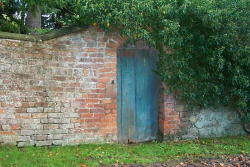
The most common boundary treatment in Ford is stone with some brick. Many of these walls are augmented by varying amounts and types of vegetation. There are examples of metal estate fencing in the village which enables views to key green spaces within the Conservation Area.
Another particular feature of Ford is the number of footpaths and bridleways which run through and radiate out from the periphery of the Conservation Area. These single-track walkways are often bounded on both sides by mature hedgerows. The footpath which runs across the culvert from New Street to the east of Ford House and along the rear of the Church is a particularly attractive attribute.
CHARACTER OF SETTING
The village lies on a gravel terrace overlooking the River Severn to the north, and the main A458 Shrewsbury to Welshpool Trunk Road runs just to the south of the village. The rolling fields bound by mature mixed thorn hedgerows to the south of the village, though not all part of the Conservation Area, contribute positively to its setting. The Cardeston Brook meanders through the village from west to east in a valley that creates a sense of enclosure and intimacy.
The Conservation Area is bounded to the north, south and west by agricultural land. These open fields form the foreground to the village as it is approached from the surrounding area, by road or on foot, giving Ford a rural setting.
SIGNIFICANCE OF SPACES
The open spaces within the Conservation Area include the extensive grounds to Ford House and Ford Hall, the churchyard and the grazing pasture between New Street and Ford House. These areas of undeveloped land are crucial to the setting of the listed buildings in the Conservation Area. The area of undulating pasture land to the front of Ford House is a particularly important characteristic of Ford. It provides a sense of space and helps to maintain the soft boundary that exists between village and countryside. These areas of undeveloped land permit excellent views both in to and out of the Conservation Area as they allow the countryside to penetrate and break up the pattern of the settlement.
CONTRIBUTION MADE BY TREES
The importance of trees, hedges and shrubs within the Conservation Area should not be overlooked. Whether for their aesthetic value such as foliage, fruit or shape or for practical reasons (for example providing shade, shelter, screening, enclosure or privacy) the use of flora helps to enhance and thus create a pleasant neighbourhood.

The contribution made by trees within the Conservation Area is moderate, due to a lack of mature indigenous trees in much of the village. However, large individual specimens and handsome groups are to be found in the grounds of Ford House and Ford Hall. There is also a splendid pair of Yews, which form a natural arch over the gateway to the Church. The Cardeston rook is lined with trees throughout its length.
