


- Main
-
Related Webpages
- Education and Learning web resources
- Interactive Maps and Town Trails
- Friends of Much Wenlock Museum
- Much Wenlock area
- Medieval Shropshire (AD 1066 to AD 1500)
- Much Wenlock c1475 Interactive map: Advice to teachers
- Medieval life in Much Wenlock
- Interactive map of Much Wenlock c1475
- A day in the life of a Cluniac monk at St.Milburga's Priory, Much Wenlock (part 2)
- A day in the life of a Cluniac monk at St.Milburga's Priory, Much Wenlock (part 1)
To expand and collapse the navigation please click on the headings
Go to other Related Subject areas


Introduction to the Interactive Map of Much Wenlock c1475

To access the map click on “Interactive map of Much Wenlock c1475” in the side menu.
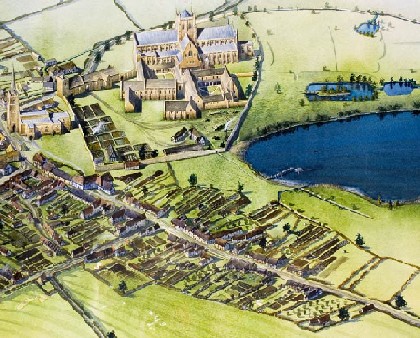
Much Wenlock reconstruction c1475
A frequent quote about Much Wenlock is that it is a place that “belongs in spirit wholly to the past”. Its appearance is that of a very small town rather than a village and it was indeed a borough from 1247 to 1948. Despite the brick or stone frontages, most buildings in the central streets contain much older, usually timber framed and often medieval, structures behind. Not so apparent today is the priory of St Milburge’s whose existence was the main reason for the growth of the town and its prosperity in the middle ages. Before its dissolution and destruction in the 16th Century the priory would have completely dominated the town, not only by the sheer bulk of its buildings, but by its economic, social and political power too. The priory’s demise was one of several reasons for the stagnation of the town in later centuries. Visitors spoke disparagingly of its cottages and mean streets, calling it “Muck Wenlock”. This neglect preserved the old houses of the town until the 20th Century when such antiquity was seen in a positive light. The result is that Much Wenlock is the best preserved medieval town in Shropshire and one of the finest in England.
The aim of the reconstruction map of the town is to portray it as it was c1475 when the town was still prosperous and the priory intact.
This reconstruction has been created by local artist Phil Kenning. It is based on meticulous research by local historians, building experts and archaeologists. Much of the fabric of the medieval town still exists, often lurking behind more modern frontages, but there is of course much that must remain conjectural. The Discovering Shropshire’s History team is very grateful to Madge Moran, author of “Vernacular Buildings of Shropshire” for her advice on the appearance of the medieval town. Dr Paul Stamper of English Heritage has given vital information about the medieval priory of St. Milburge’s as have Prof. Mick Aston and Dr Mark Horton. We also readily acknowledge the strong influence on this image of the reconstruction of the medieval priory drawn by Charles Nicholson in 1927.
This reconstruction was commissioned and entirely funded by the Shrophire Archaeological and Historical Society.
To access the map click on “Interactive map of Much Wenlock c1475” in the side menu.
