


- Main
-
Related Webpages
- Discovering Shropshire's History
- Medieval Shropshire (AD 1066 to AD 1500)
- Introduction to the Interactive Map of Much Wenlock c1475
- Friends of Much Wenlock Museum
- Interactive map of Much Wenlock c1475
- A day in the life of a Cluniac monk at St.Milburga's Priory, Much Wenlock (part 2)
- A day in the life of a Cluniac monk at St.Milburga's Priory, Much Wenlock (part 1)
To expand and collapse the navigation please click on the headings
Go to other Related Subject areas


Much Wenlock c1475 Interactive map: Advice to teachers

To access these resources click on "Interactive map of Much Wenlock c1475" in the side menu.
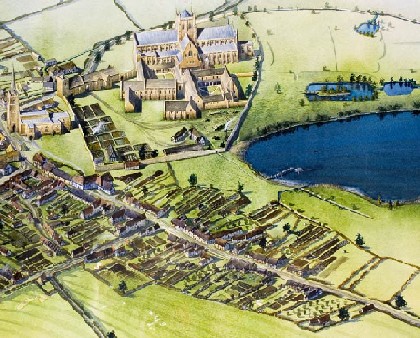
Much Wenlock reconstruction c1475
These interactive resources are intended for use mainly by Key stage 3 pupils (11-14 year olds) studying the impact of monasteries in medieval times. They aim to help pupils and teachers grasp the opportunities presented by changes to the draft programme of study for History. They provide historical sources, particularly images, for use and evaluation. Most importantly they allow pupils, especially those in Shropshire and the West Midlands, a chance to examine aspects of their local history and how they relate to a broader historical context. Pupils can analyse and evaluate how the past has been interpreted through the medium of a reconstruction painting and can see through the well preserved physical remains of Much Wenlock how the legacy of the Middle Ages is still with us today.
St. Milburga’s priory was the largest monastery in Shropshire, and one of the largest in the country. Its monks were of the Cluniac branch of the Benedictine order. In these pages pupils can follow a typical day in the life of a Cluniac monk; examine the role the monastic buildings played in the life of the Cluniac order and of the local community; and see the way the monastery physically, economically and culturally dominated the small market town that grew up outside its walls.
To access these resources click on "Interactive map of Much Wenlock c1475" in the side menu.
